How To Recover From Trading Drawdowns Without Revenge Trading
A practical recovery framework for EURUSD traders after a losing stretch: reduce size, protect your decision quality, and rebuild confidence without trying to win everything back in one trade.
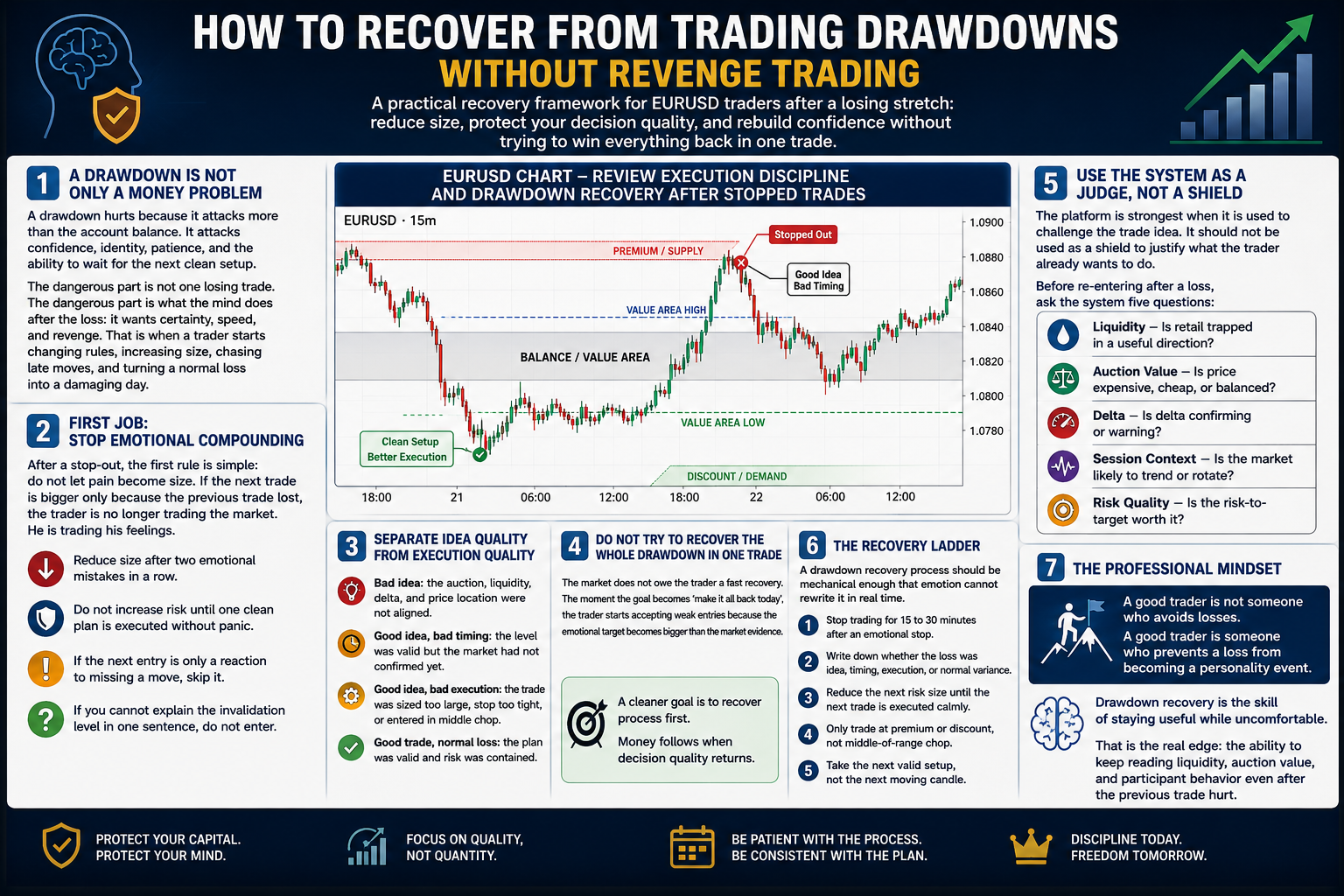
A drawdown is not only a money problem
A drawdown hurts because it attacks more than the account balance. It attacks confidence, identity, patience, and the ability to wait for the next clean setup.
The dangerous part is not one losing trade. The dangerous part is what the mind does after the loss: it wants certainty, speed, and revenge. That is when a trader starts changing rules, increasing size, chasing late moves, and turning a normal loss into a damaging day.
First job: stop emotional compounding
After a stop-out, the first rule is simple: do not let pain become size. If the next trade is bigger only because the previous trade lost, the trader is no longer trading the market. He is trading his feelings.
The best professional response is to cut risk temporarily. That does not mean losing confidence. It means protecting the part of the mind that still sees the market clearly.
- Reduce size after two emotional mistakes in a row.
- Do not increase risk until one clean plan is executed without panic.
- If the next entry is only a reaction to missing a move, skip it.
- If you cannot explain the invalidation level in one sentence, do not enter.
Separate idea quality from execution quality
A losing trade does not automatically mean the idea was wrong. Sometimes the idea was right, but the entry was too early. Sometimes the entry was fine, but the stop was placed inside normal volatility. Sometimes the market simply changed.
This separation matters because a trader who labels every loss as failure learns the wrong lesson. The review should classify the loss before changing the system.
- Bad idea: the auction, liquidity, delta, and price location were not aligned.
- Good idea, bad timing: the level was valid but the market had not confirmed yet.
- Good idea, bad execution: the trade was sized too large, stop too tight, or entered in middle chop.
- Good trade, normal loss: the plan was valid and risk was contained.
Do not try to recover the whole drawdown in one trade
The market does not owe the trader a fast recovery. The moment the goal becomes 'make it all back today', the trader starts accepting weak entries because the emotional target becomes bigger than the market evidence.
A cleaner goal is to recover process first. Money follows when decision quality returns.
Use the system as a judge, not a shield
The platform is strongest when it is used to challenge the trade idea. It should not be used as a shield to justify what the trader already wants to do.
Before re-entering after a loss, ask the system five questions: is price at a meaningful auction edge, is retail trapped in a useful direction, is delta confirming or warning, is the level accepting or rejecting, and is the risk-to-target worth it?
- Liquidity tells you who may be trapped.
- Auction value tells you whether price is expensive, cheap, or balanced.
- Delta tells you whether the move has pressure behind it.
- Session context tells you whether the market is likely to trend or rotate.
- Risk quality tells you whether the trade is worth capital.
The recovery ladder
A drawdown recovery process should be mechanical enough that emotion cannot rewrite it in real time.
The first trade after a painful loss should be a small, clean, obvious trade. Not because small trades make a lot of money, but because they rebuild obedience. The account recovers when discipline recovers.
- Step 1: stop trading for 15 to 30 minutes after an emotional stop.
- Step 2: write down whether the loss was idea, timing, execution, or normal variance.
- Step 3: reduce the next risk size until the next trade is executed calmly.
- Step 4: only trade at premium or discount, not middle-of-range chop.
- Step 5: take the next valid setup, not the next moving candle.
The professional mindset
A good trader is not someone who avoids losses. A good trader is someone who prevents a loss from becoming a personality event.
Drawdown recovery is the skill of staying useful while uncomfortable. That is the real edge: the ability to keep reading liquidity, auction value, and participant behavior even after the previous trade hurt.
Use the platform as a decision process.
The goal is not to copy one level. The goal is to learn how auction value, retail behavior, liquidity pressure, delta, and risk rules combine into a trade idea.