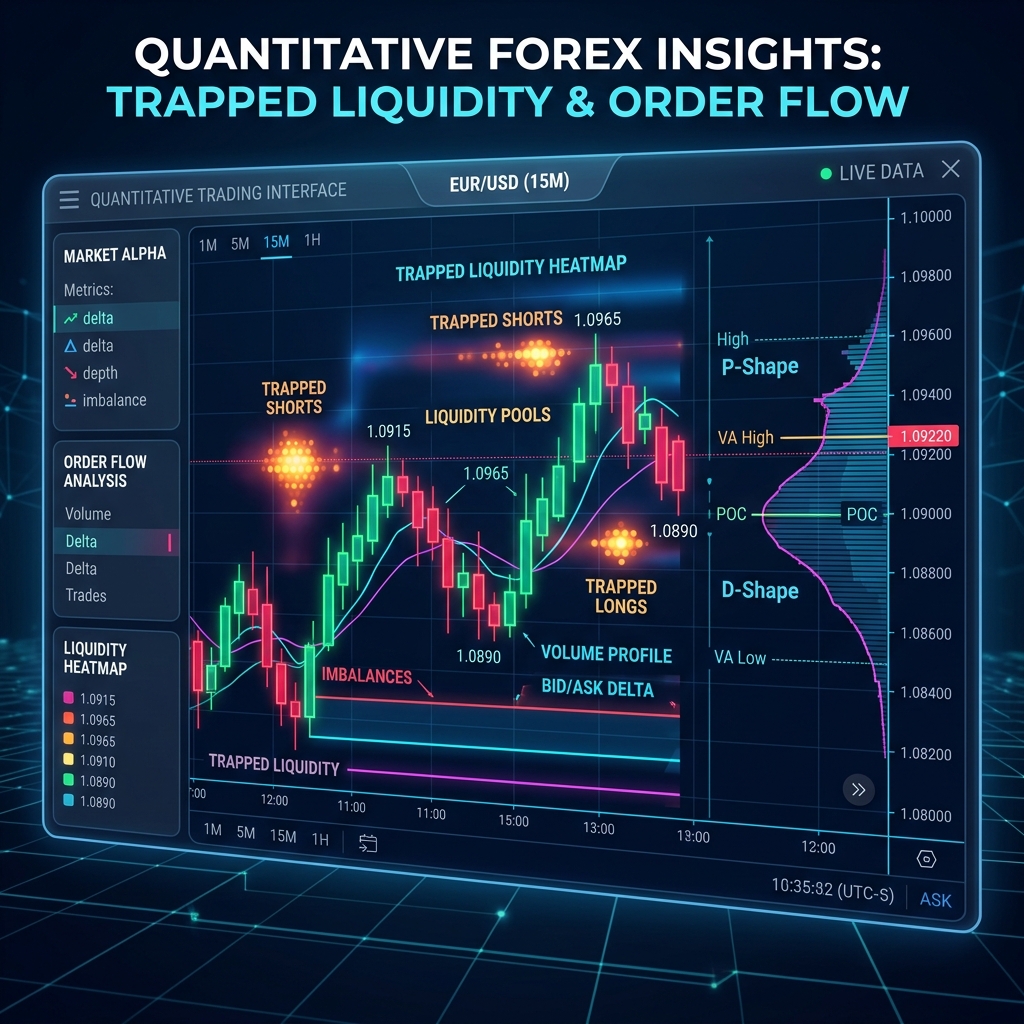
How To Read TradingAnalytica For EURUSD Trade Ideas: A Step-By-Step Workflow
A retail trader workflow for turning the dashboard, auction model, liquidity heatmap, delta, and alerts into a disciplined EURUSD trade idea.
Start with the question, not the trade
The first mistake is opening the platform and asking: should I buy or sell right now? That puts pressure on the system to give you a signal.
A better question is: what kind of market is this today? Is price accepting value, rejecting value, rotating inside a box, or running stops in a headline-driven session?
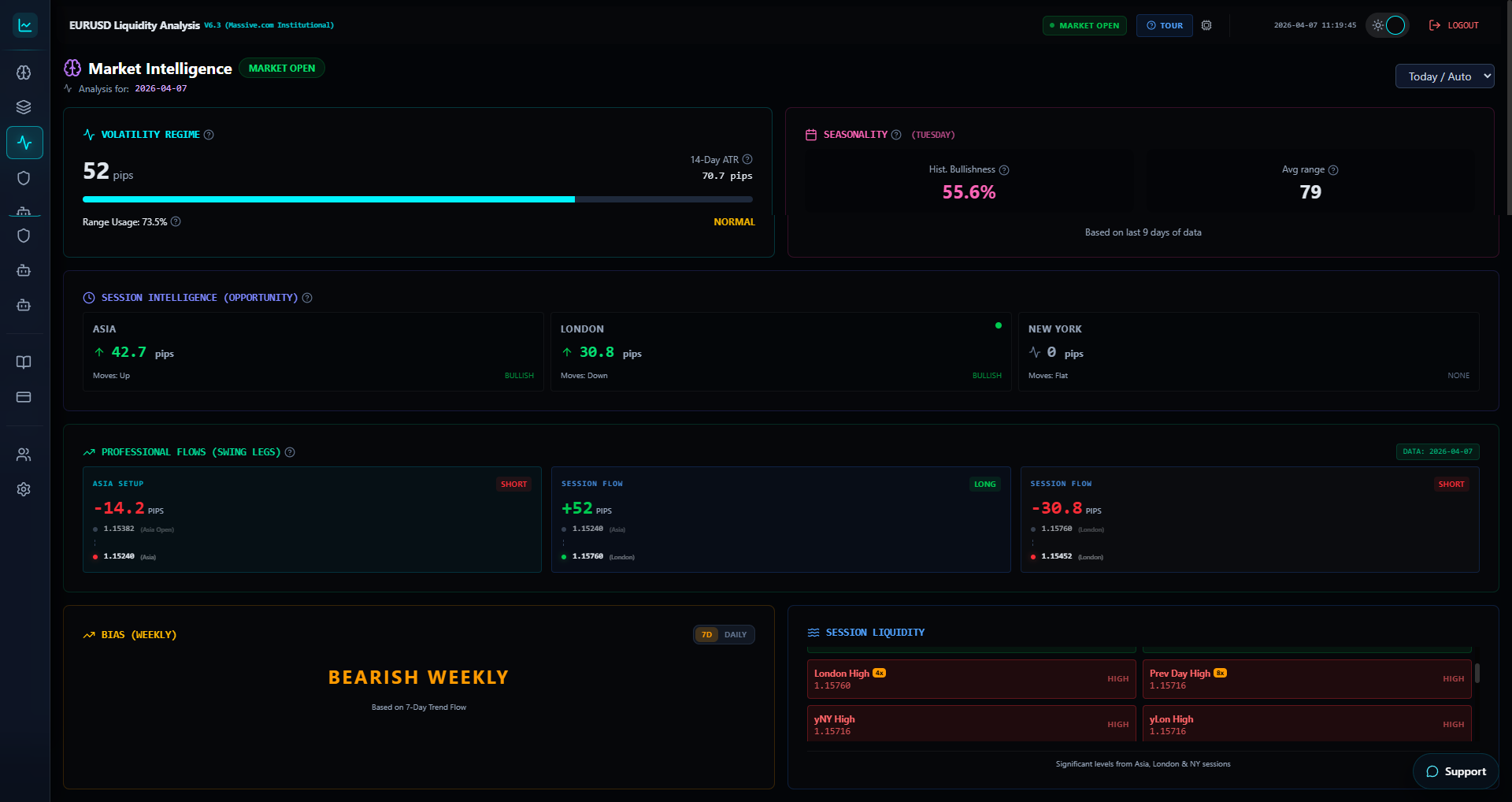
Step 1 - Read the market state
Start on the main dashboard or market intelligence view. Look for the current session, current price, market-open status, and whether the narrative says the auction is trending, balancing, accepting lower, accepting higher, or rejecting a zone.
This is the top-down context. It tells you whether you should expect continuation, rotation, or patience.
- If value is migrating lower, prefer sell retests instead of chasing lows.
- If value is balanced, expect chop until one side accepts outside the range.
- If the narrative is event-driven, reduce size and wait for confirmation.
Step 2 - Check auction levels
Move to the auction context: VAH, POC, VAL, profile shape, and value migration. These are not magic lines. They are the market's recent agreement about fair and unfair price.
A short idea is cleaner when price is below value, POC is migrating lower, and a bounce into prior value fails. A long idea is cleaner when price reclaims value and holds above the accepted area.
Step 3 - Read the liquidity heatmap
Open the liquidity heatmap or anatomy view. Do not only look for the largest bar. Ask what kind of liquidity it is: passive limits, aggressive stops, trapped positions, or winning positions.
The best areas are usually not the closest areas. They are the levels where trapped inventory and passive liquidity combine, because those zones can create a reaction when price retests them.
- Passive sell limits above price can mark supply.
- Trapped longs above price can become sellers on a retest.
- Trapped shorts above price can become buy-stop fuel if price squeezes.
- Buy limits below price can create support but can also be absorbed.
Step 4 - Read retail behavior through change, not one snapshot
A single retail percentage is only a snapshot. The edge is in how retail changes while price moves.
If price drops and retail longs increase, retail is buying the dip. That can become trap-loading. If price rallies and retail longs fall, the rally may be driven by short covering or larger flow instead of fresh retail buying.
Step 5 - Use delta as confirmation or warning
Delta and synthetic pressure tell you whether the move has backing. Positive pressure into a resistance zone can mean buyers are strong, but if price fails anyway, that can also expose absorption.
If your short idea depends on a level rejecting, but pressure is strongly positive and price keeps accepting higher, the level is not ready. Wait.
Step 6 - Treat alerts as research hypotheses
A shadow alert is not a command. It is the system saying: this pattern is worth studying right now.
Before using any alert for a trade idea, check whether price is already too far from entry, whether the level has already been tagged, whether news risk is active, and whether the auction agrees.
Step 7 - Build a limit plan, not a chase
Most of the best trades in the May 20-22 study came from waiting for retests. The system ladder generated sell levels above current price because the plan was to let price come back into supply.
A clean plan has entry, stop, target, invalidation, time risk, and setup quality. If setup quality is A, risk can be higher. If setup quality is B, use probe size. If it is unclear, do nothing.
- Entry should be at a meaningful retest, not inside random chop.
- Stop should sit beyond the structure, not inside the normal wick zone.
- Targets should respect support, prior lows, and trapped-short cover zones.
- Cancel rules matter as much as entry rules.
Step 8 - Review the trade after it closes
The platform becomes more useful after the trade, not only before it. Compare what you expected against what actually happened.
Did price respect the auction level? Did retail reload? Did liquidity absorb or migrate? Did delta warn you early? This review is how a trader becomes less dependent on alerts and more fluent in market behavior.
Use the platform as a decision process.
The goal is not to copy one level. The goal is to learn how auction value, retail behavior, liquidity pressure, delta, and risk rules combine into a trade idea.