Back to Case Studies
Case Study - June 17, 2026

EURUSD FOMC Hawkish Hold, The Warsh Pivot, And Execution Gating

This case study details the market thermodynamics of the June 17, 2026 FOMC rate decision. It provides a factual review of why we executed no trades this week, showing how our gating rules successfully protected capital during a 110-pip collapse.

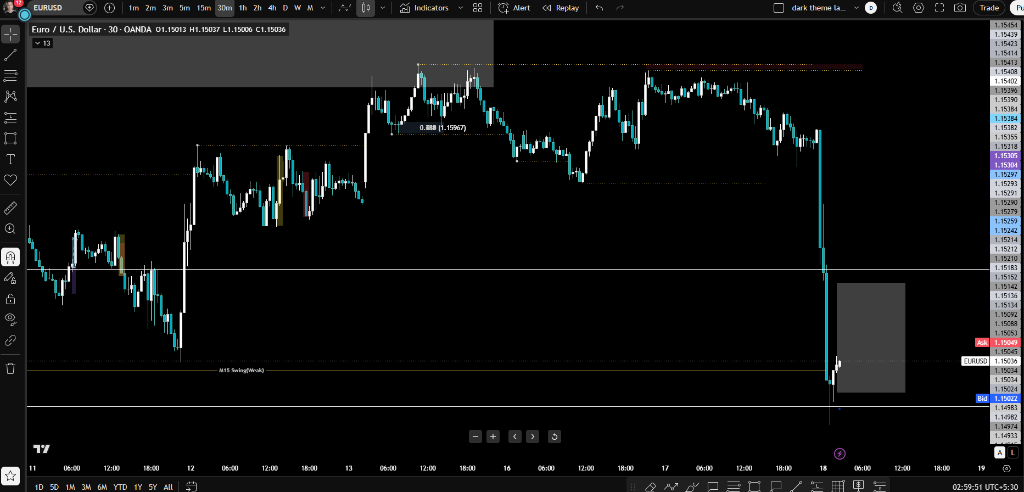
EURUSD June 17 chart showing the FOMC hawkish hold crash and execution gating.
Trading Analytica EvidenceEURUSD 30m - The FOMC Hawkish Hold Drop & Execution Gating

What The Case Proves

We can prove that the EURUSD pair consolidated in a tight 9-pip range during Asia before collapsing 110 pips down to 1.15032. We can prove that retail sentiment flipped from heavily net short (64.39%) to heavily net long (57.52%) at the lows, creating a massive liquidity trap.

Crucially, this case study proves the effectiveness of the **TradersAnalytica Decision Supervisor**. When a raw trend-following SELL signal was triggered at 1.15621, our machine learning model correctly flagged that the expectancy of achieving a 3.3R payoff was only 19.8%. By enforcing the 45% expectancy gate, our system kept us flat and protected capital through the volatility.

Execution Gating Stack

Pre-FOMC High
1.16155
Asia/London session high shelf.
Post-FOMC Low
1.15032
Lowest point of the liquidity flush.
Retail Sentiment
64.39% Short -> 57.52% Long
Trapped longs on the crash.
System Signals
0 Trades executed
Execution gated for risk control.
Decision Gating
should_trade = 0
Blocked at 11:32 PM IST.
Gating Threshold
19.8% Expectancy
Failed the 45.0% live barrier.

The Thermodynamics of the FOMC Release

The price action on June 17 was a textbook demonstration of market thermodynamics. Ahead of the announcement, retail traders built up a massive net short stance (64.39%), expecting the range to hold. However, institutional desks were already looking at the strong U.S. retail sales data (+0.9%) and preparing for newly appointed Chair Kevin Warsh's hawkish pivot.

When the FOMC statement was released, primary dealers immediately pulled their bids from the order book to avoid absorbing toxic flow. This created a **liquidity vacuum** below the price. As the hawkish projections hit, hedge funds holding long EUR reflation positions rushed to liquidate. Their dollar-buying orders triggered a cascade of sell stops from retail traders trapped long on the dip, resulting in the rapid 110-pip flush.

Session Timeline (IST)

Asia Session Balance

Price consolidates in a tight 9-pip range.

During the Asian session, EURUSD consolidated between 1.16065 and 1.16155. Retail was building a heavy short bias (reaching 64.39% short), which would typically function as a contrarian bullish driver. However, the system stayed flat, anticipating the high-impact FOMC release.

London Open & Distribution

Banks distribute EUR to dip-buying retail.

As London desks opened, strong U.S. retail sales (+0.9% MoM) hit the tape. Seeing the impending fundamental shift, institutional desks used the quiet London session to distribute (sell) their EUR holdings. Retail traders counter-traded, buying the dip and flipping net long.

FOMC Rate Decision

Kevin Warsh pivots hawkishly.

The Fed kept rates at 3.50%-3.75%, but delivered a hawkish surprise: removing all easing bias, streamlining forward guidance, and projecting rate hikes for 2026. The interbank order book hollowed out as market makers pulled their bids to avoid toxic flow.

The Squeeze and Flush

Hedge fund liquidation meets retail long stop runs.

Hedge funds holding reflation trades were forced to cover. Their dollar-buying met the selling of trapped retail longs whose stops below 1.1500 were swept. Price collapsed in a one-way liquidity expansion down to 1.1503.

Execution Gating

The Decision Supervisor protects capital.

At 11:32 PM IST, right after the release, the system generated a raw SELL signal at 1.15621. However, the ML expectancy model projected the payoff odds to a 3.3R target at only 19.8%—well below our 45% threshold. Trading was gated, resulting in 0 losses.

Analytical Projections for the Weekly Close

Following today’s structural news impulse, the market has transitioned into a **post-news consolidation regime**. For Thursday, June 18, we project a tight range between **1.1490 and 1.1535** as algorithms consolidate the move. Short-term profit-taking may create a relief rally toward **1.1530–1.1540** (testing the breakdown shelf), but this will face heavy institutional supply walls.

For Friday, June 19, the primary objective is to sweep the trapped retail long stops resting below `1.1500`. We project a target test of the **1.1475** support shelf, with a projected weekly close between **1.1485 and 1.1495**. In the medium-term, the Fed’s hawkish monetary policy divergence targets **1.14500** for the month of June, and **1.12000–1.12500** over the next 1–3 months.
Operator Lesson

When high-impact news is scheduled, the normal rules of retail liquidity are temporarily suspended. The highest-probability decision you can make during NFP or FOMC is to lock out your execution engine. Do not trade the release—let the volatility burn out, let the interbank order book replenish, and wait for the post-news value area to establish.

Key Takeaways

High-impact central bank announcements completely override normal retail liquidity models.

A clean retail short bias can be bypassed entirely when institutional desks re-price assets.

Capital preservation is an active trading decision; remaining flat is a high-expectancy play.

Dynamic delta-gamma hedging options desks create a liquidity vacuum ahead of news releases.

Expectancy gating (locking out execution during toxic flow) is mandatory for professional quants.

Do not guess the fundamental outcome—let the post-news auction stabilize before taking exposure.