EURUSD Case Study: The June 3 Liquidity Trap
A practical review of the June 3 flush through the 1.16000 psychological barrier, the massive 65% retail long trap, and why you can never buy the lower edge when the crowd is overwhelmingly long.
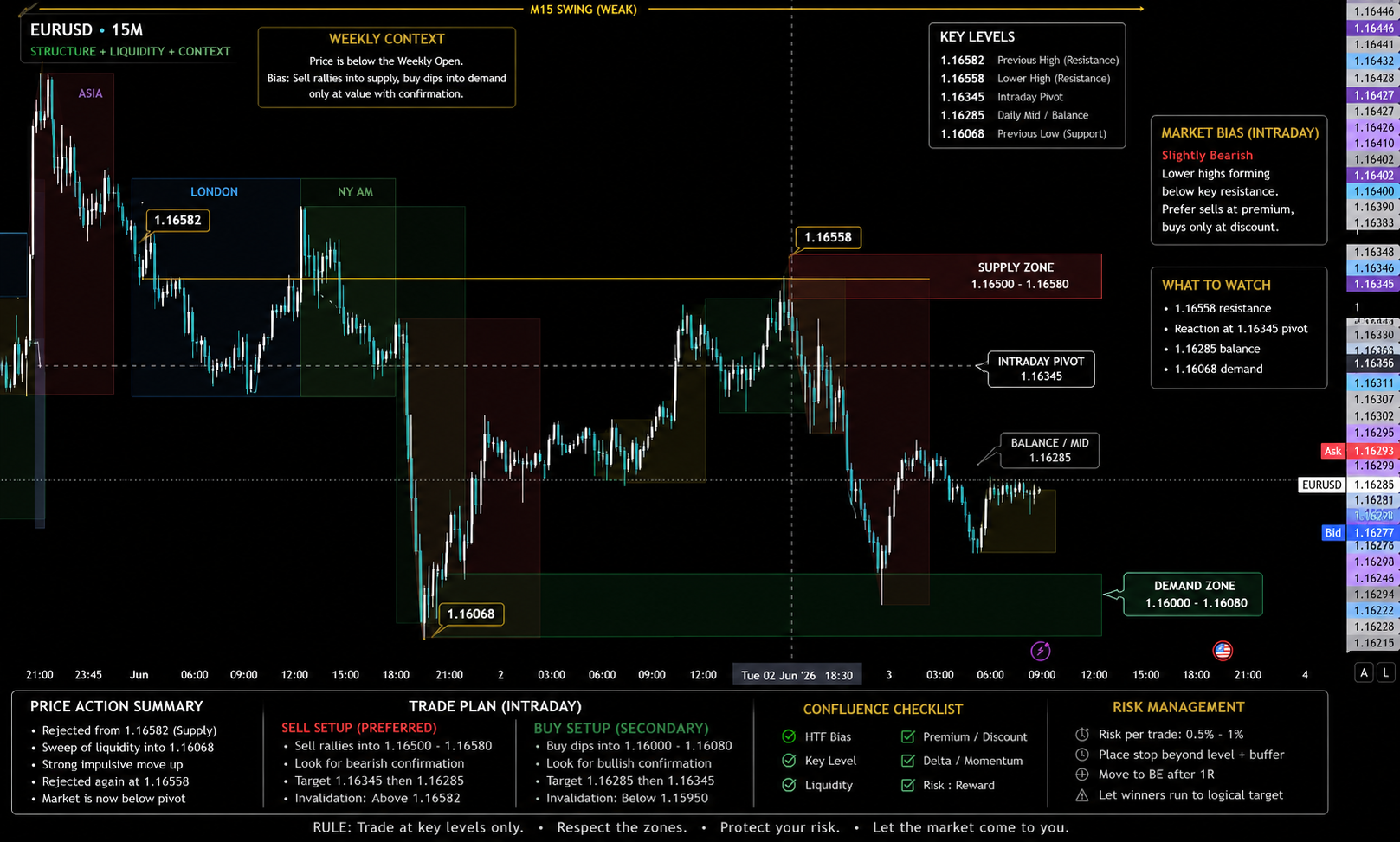
The Macro Setup: A One-Way Retail Street
The day began with the market already rotating heavily, but the most important data point was not on the price chart—it was in the positioning book.
Throughout the London and New York sessions, retail traders aggressively faded the bearish momentum. As price dropped from the 1.16400s, the crowd did not capitulate; they bought the dip. By the middle of the New York session, Total Retail Longs hit an extreme 62.74%, with over 56% of those longs trapped underwater.
The algorithmic path of least resistance was set: the market had massive gravitational pull to the downside to liquidate that 62% long exposure.
The 1.16100 Magnet and the Rotation Trap
During the London/NY handoff, price hovered right around the 1.16114 mark.
Many traders identified the 'Rotation Lower-Edge Long' playbook setup here, noting that the absolute lows seemed rotational. However, the fifth condition of that playbook was violently violated: You cannot buy the lower edge of a rotation if the crowd is overwhelmingly long.
- For a lower-edge squeeze to work, you need trapped shorts below you to fuel the bounce.
- Instead, we had a massive cluster of trapped longs above.
- A giant magnet of pending retail limit buy orders was sitting at the 1.16000 psychological round number.
The Inevitable Flush (End of Day Read)
The market did exactly what the liquidity data demanded. It ignored the minor intraday bounces, failed to reclaim the 1.16150 resistance, and initiated a brutal liquidation cascade.
The 1.16100 level shattered. The 1.16000 psychological defense broke. The day closed near 1.15976.
- Total Retail Long expanded to 65.22% as traders kept buying the falling knife.
- Total Longs in Loss reached a catastrophic 55.99%.
- The algorithmic sweep fully capitalized on the retail pain.
The Operator Lesson
This is why we respect the macro liquidity trap above all else.
If you tried to buy the 'rotational low' today at 1.16130, and you did not have a strict, non-negotiable stop loss at 1.16078, you would be sitting in an uncontrollable drawdown as the market closed under 1.16000.
Because we identified the 62% long trap early, the system bias was unequivocally SHORT. The only valid execution was to wait for an intraday squeeze into premium supply and short the rollover, or to simply stay out of the way of the falling knife.